
Common Questions
Vedic basics
Choosing your gem
Buying from us
Western vs. Vedic Astrology
The Difference Between Tropical and Sidereal Astrology
The main difference between Western and Vedic astrology is where the zodiac starts. Western astrology starts Aries on the first day of spring, so its signs follow the seasons. Vedic astrology, or Jyotish, measures the signs against the stars, and since the two lined up, about 1,700 years ago, they have drifted about 24 degrees apart. So the same birth date, time and place give two different charts, and most of your planets sit one sign earlier in the Vedic one.
As for which is more accurate, I’m of the opinion that Vedic astrology is, and it’s the only system we use to recommend gemstones. Its zodiac matches the sky overhead, and it reads your chart from your rising sign, which changes about every two hours, rather than your Sun sign, which changes once a month.
Which Is More Accurate, Vedic or Western Astrology?
If you ask 10 different astrologers which system is more accurate, you’re going to get 10 different answers, and there are good astrologers working in both. The two are also used for different things. Western astrology is used predominantly for character assessment, and it describes personality well. Vedic astrology is more remedial in nature. It takes the weaknesses of the birth chart into account, and when they’re likely to come up, so that actions can be taken to remedy challenging karma, such as wearing Jyotish gemstones or chanting planetary mantras.
I trust Vedic astrology more because it places every planet where you’d actually see it against the stars. Western astrology places them by the seasons, and the seasons slip against the stars by about one degree every 72 years. Since the two zodiacs lined up, about 1,700 years ago, that has added up to about 24 degrees, almost a whole sign, and Western astrology hasn’t adjusted for it. Vedic astrology will always depict the actual planetary positions in the night sky, and we suspect that the ancient cultures who honored the night sky would appreciate that.
Whichever system you use, a chart is only as accurate as the birth time it’s built on. The rising sign moves about one degree every four minutes, so a birth time that’s off by half an hour can give you the wrong rising sign, and with it the wrong house for every planet in the chart.
Why Is My Sign Different in Vedic Astrology?
In ancient times, people spent a great deal of time looking up at the night sky. The stars were a source of light, a tool for navigation, and inspiration for legend and lore. They watched, year after year, as the star cycles overhead corresponded with subtle changes down on earth. The ancients became so skilled at observing these cycles that their study became a tool to predict the future. This is the origin of astrology.
The part of the night sky used in astrology is called the Zodiac, a band of stars where the Sun, Moon, and the planets in our solar system appear to move. This band of sky also includes 12 constellations, or clusters of stars known as the “Zodiac Signs.”
In all systems of astrology, the first sign of the Zodiac is Aries. In Western astrology, Aries always starts on the vernal equinox, the first day of spring. However, there’s a problem with this. The Earth wobbles very slowly on its axis, like a spinning top, so the spot in the stars where the Sun sits on the equinox slides backwards a little every year. It’s a very small shift, but over the course of 2,000 years it’s made a big difference. The signs are, very slowly, scooting backwards, and this is known as the precession of the equinox.
What does this mean for astrology? Here in the 21st century, the Sun is literally overhead in Pisces on the vernal equinox, at about 6 degrees of Pisces, the 12th sign of the Zodiac. But Western astrology still stubbornly says that the Sun is in Aries on that day.
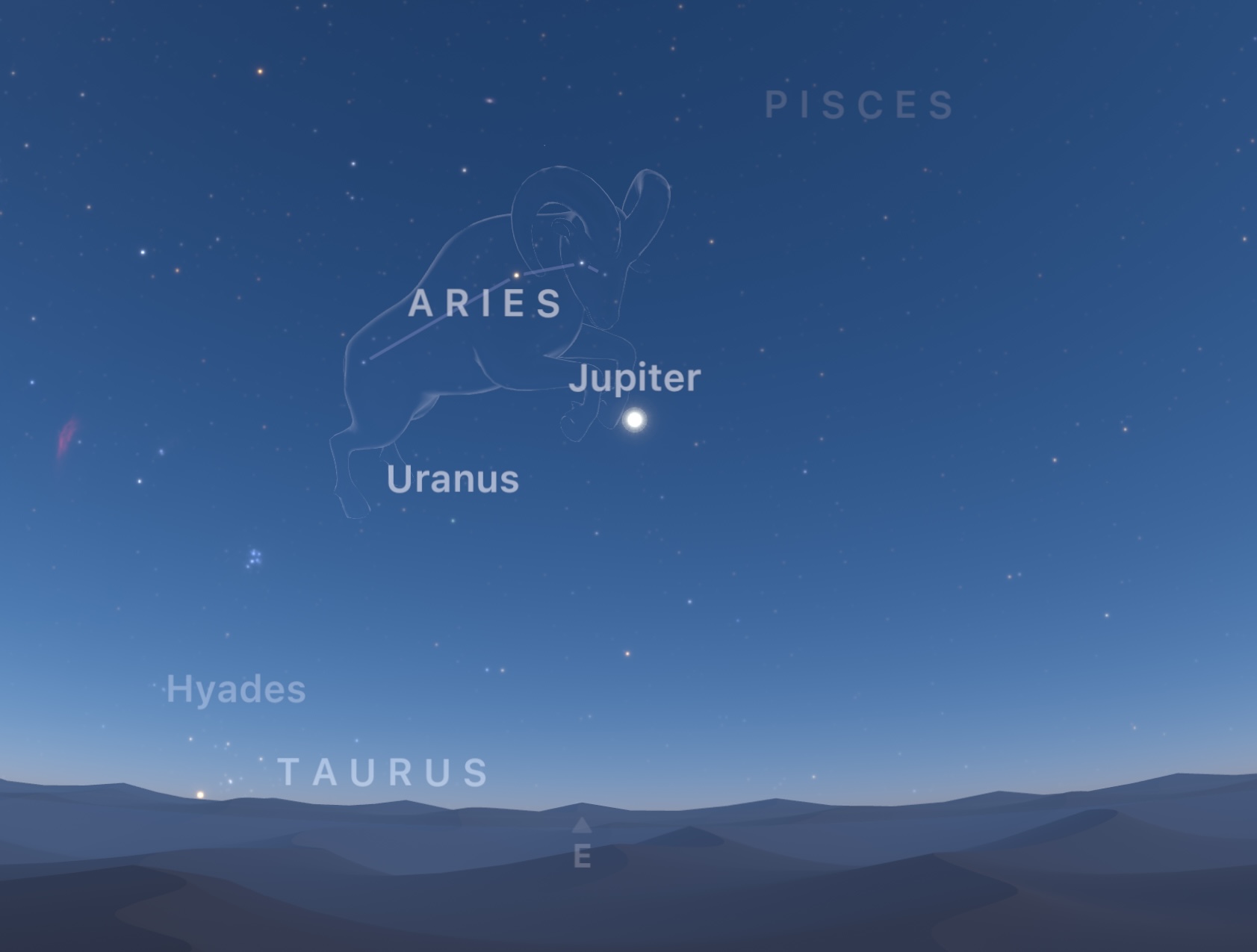
In this star chart from January 2024, Jupiter is in the stars of Aries. Western astrology had it in Taurus.
Vedic astrology uses calculations that reflect exactly what is happening overhead.
So if a planet sits in the first 24 degrees or so of its Western sign, it falls in the sign before it in your Vedic chart, which is true of about four out of every five placements. A Western Leo Sun at 10 degrees is a Vedic Cancer Sun, and a Western Leo Sun at 28 degrees is still a Leo. The same goes for your Moon and your rising sign, which is why most people’s Vedic chart looks quite different from the one they know.
Find your Vedic rising sign with our Free Gem Report here.
Is Vedic Astrology the Same as Sidereal Astrology?
Vedic astrology uses the sidereal zodiac, measured against the stars, and Western astrology uses the tropical zodiac, measured against the seasons. That’s why you’ll often see the two called sidereal and tropical astrology. But not all sidereal astrology is Vedic. A small number of Western astrologers use the sidereal zodiac with Western methods, while Vedic astrology brings its own methods along with the zodiac, and those are the main differences below.
Sidereal astrologers also differ a little on exactly how far the two zodiacs have drifted apart. That figure is called the ayanamsa, the measure of the drift. Most Vedic astrologers use the Lahiri ayanamsa, about 24 degrees today. A degree either way only changes a placement that sits right at the edge of a sign, but it’s one reason two chart websites can show slightly different degrees for the same birth.
Main Differences in Western vs. Vedic Astrology
Western and Vedic astrology both use Zodiac signs of 30 degrees each to create the wheel of the horoscope, with mostly identical names and planetary references used throughout the systems. However:
1. The rising sign and the Moon
In Western horoscopes, the emphasis is on Sun signs. Your “sign” is the one the Sun was in when you were born, which changes once every month. Vedic astrology predominantly looks at the rising sign, also called the Ascendant, the sign on the eastern horizon at the time of your birth. It changes signs about once every two hours, so it’s much more specific to your individuality than the Sun sign. We have found, time and time again, that looking at the birth chart from the vantage point of the Ascendant is the most accurate way to recommend gemstones.
Vedic astrology also reads transits and significations from the vantage point of the Moon, so it gives the Moon’s position far more weight than Western astrology does.
2. Nine planets, including Rahu and Ketu
Vedic astrology works with nine planets: the Sun, Moon, Mars, Mercury, Jupiter, Venus and Saturn, plus Rahu and Ketu, the north and south nodes of the Moon. Rahu and Ketu are the two points where the Moon’s path crosses the Sun’s path, which is where eclipses happen. They have no physical body, but Vedic astrology treats them as planets in their own right, each with its own gemstone. Western astrology uses the nodes more lightly, and adds Uranus, Neptune and Pluto, which traditional Vedic astrology leaves out.
Learn more about Rahu, the north node, here. Learn more about Ketu, the south node, here.
3. Planetary periods
Vedic astrology divides a life into planetary periods called mahadashas. (Mahadashas are like chapters of a book, where the presiding planet creates an underlying theme of lessons for that whole period.) They come in a fixed order and last from 6 years for the Sun to 20 years for Venus, so a Vedic astrologer can tell you whose period you’re in now and which planet comes next. Western astrology times events mostly by transits and progressions, so this is the biggest difference in how the two systems make predictions.
4. Divisional charts
Vedic astrology also reads divisional charts, smaller charts worked out from the main one, each read for one part of life. The best known is the ninth-division chart, read for marriage and for how strong each planet really is. Western astrology rarely uses anything like them.
Gemstone Prescriptions
Both systems use gemstones, but they do so differently.
In Western astrology, there are birthstones for each month or Sun sign, but their meanings are not deeply connected to the signs. Not much study has been done on the effectiveness of commercial quality birthstones for the wearer’s Western astrological chart.
In Vedic astrology, gemstones are associated with the planets rather than the Zodiac signs, and each of the nine planets has its own traditional gem, from ruby for the Sun to cat’s eye for Ketu. Gem prescriptions are highly personalized, considering an individual’s entire birth chart as well as their intentions for wearing gems, to make sure the gemstones are worn for the right reasons. The same gemstone that supports one person might be completely inappropriate for another person’s chart. In Jyotish, a well-chosen gem is believed to help, and the wrong one to work against you, so it’s best to consult a qualified Vedic Gemologist before you buy.
Read more about how Vedic gems differ from birthstones here.
Your rising sign is where this starts, but your planetary placements and your current periods change which gem is right for you. If you’d like me to look at your whole chart, consultations are $108, and that’s credited back with the purchase of any gemstone over $500. You can order a written consultation here.